The valet stand is empty and the gardener is holding a sign
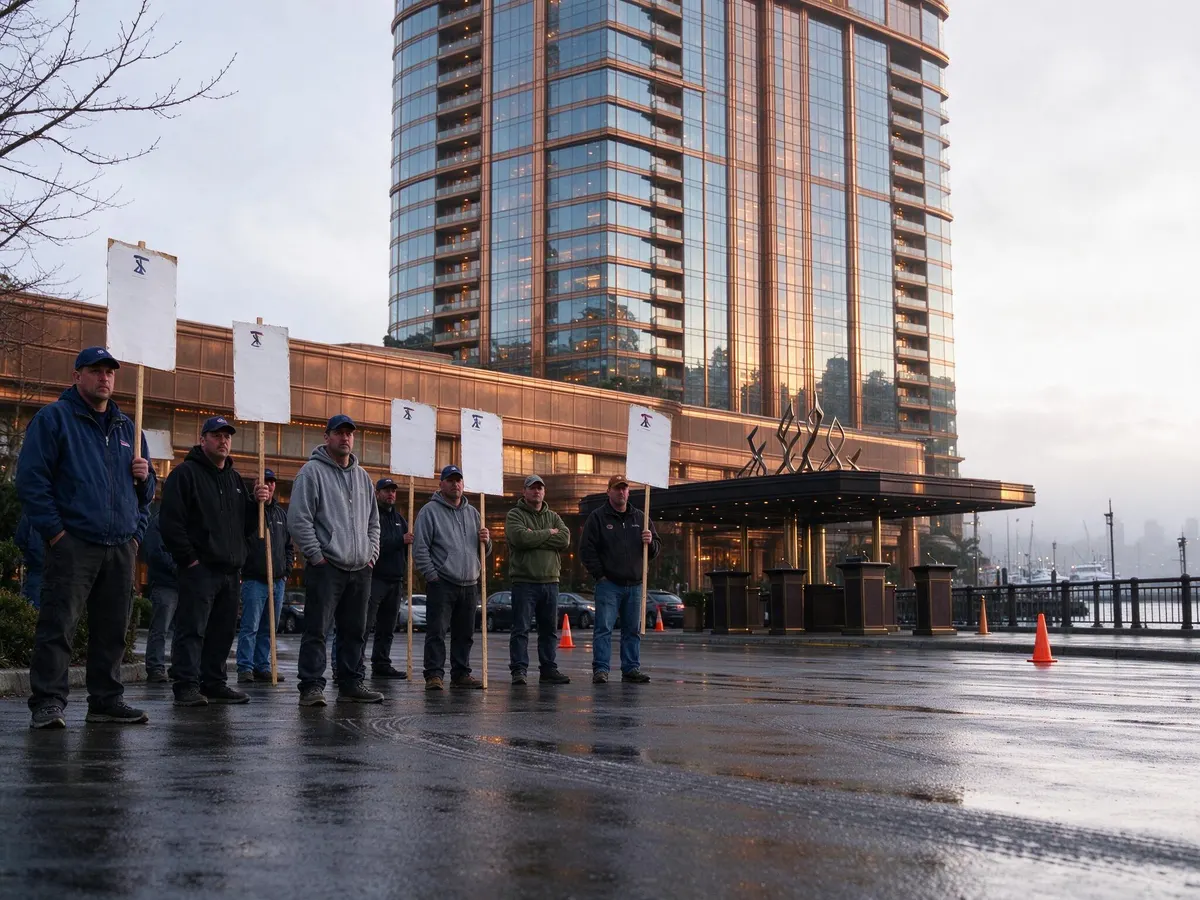
The first thing a guest arriving at the resort would have noticed is that nobody took the car. The Encore Boston Harbor strike pulled more than 1,300 workers off the property on a Friday, and among the 211 Teamsters who walked out are the valet attendants, the limo drivers, the dispatchers and the traffic attendants. Also the warehouse crew, the call centre staff, the cage cashiers, the guest experience attendants, and the horticulture team, which is how you end up with a lead gardener as one of the public faces of a casino labor dispute.
That gardener, James Atkins, is chief steward at Teamsters Local 25. “We didn’t want to strike, but we won’t accept a contract that blatantly disrespects our labor,” he said, adding that the picket line would stay up “as long as it takes to get a fair deal.” Thomas Mari, Local 25’s president, was blunter about management’s approach to the bargaining table: “When a company refuses to respect the workers who make its profits possible, we shut it down.”
Wynn Resorts, which owns the property, says the opposite is happening. “Encore Boston Harbor remains open and operational, and we stand ready to service our guests while we continue negotiations,” the company said, framing the walkout as a choice the unions made “despite our continued efforts to reach an agreement.”
Both of those statements can be true at once. That gap is where the story actually lives.
How it got here
The sequence is not complicated. The contract covering the union workforce, represented by UNITE HERE Local 26 and Teamsters Local 25, expired on 31 August. Members had already voted in August to authorise a strike, which is the standard way a union tells an employer that the deadline is real. No replacement deal arrived. According to the Teamsters, Encore management then declined to return to bargaining with any meaningful improvements, even after the authorisation vote. So the line went up.
What the unions want is the usual three-part package: better wages, stronger benefits, and firmer job protections. That third item is the one worth paying attention to, and I’ll come back to it.
Two sets of numbers, both technically accurate
Casino labor fights are argued in figures, and each side has picked the ones that flatter it. The unions point to roughly $847 million in revenue at the resort last year. Encore counters with compensation: average pay and benefits for union-represented employees exceed $95,000 a year, and over the past four years union wages and benefits have risen 36.8% while revenue grew 1.9%.
Here is the arithmetic laid out, because reading it side by side is more useful than reading either press release.
| Figure | Value | Cited by |
|---|---|---|
| Annual property revenue (last year, estimated) | ~$847 million | Unions |
| Average union compensation and benefits | Over $95,000 per year | Encore |
| Growth in union wages and benefits, past four years | +36.8% | Encore |
| Revenue growth over the same four years | +1.9% | Encore |
| Voluntary turnover | 3.9% | Encore |
| Union employees who say they are proud to work there | 86% | Encore |
| Union employees who plan to stay | 83% | Encore |
| Q2 operating revenue, Encore Boston Harbor | $209.3 million, down $6.4 million year on year | Wynn Resorts |
| Q2 table games win percentage | 18.1% (expected range 18%–22%) | Wynn Resorts |
| Workers on strike | More than 1,300, including 211 Teamsters | Unions |
The 36.8% versus 1.9% comparison is the sharpest weapon the company has, and it is a real problem for any operator: labor cost compounding at nearly twenty times the rate of top-line growth is not sustainable indefinitely. The union’s reply is implicit in the $847 million figure, which says the property is large and profitable enough to absorb more. Neither number settles it. They just mark out the bargaining range.
A note on that 18.1%, since people misread it
Wynn reported second-quarter operating revenue of $209.3 million from the property, down from $215.7 million a year earlier, with table games win percentage at 18.1% against 21.3% in the same quarter last year. Win percentage, or hold, is the share of the money players buy in with that stays with the house. It is driven by the built-in house edge on each game, how long people play, and plain variance. A quarter at the low end of an 18% to 22% expected range means players as a group ran better than usual at the tables. It does not mean the games changed, and it has nothing to do with the strike, which came later. It is simply worth knowing that the property went into this negotiation with a softer quarter behind it, which tends to make management less generous and unions no less determined.
What a guest actually experiences
Look again at the job titles on the picket line. Valet, cage cashiers, call centre, guest experience attendants, warehouse. Those are not back-office roles. They are the friction points of a visit: parking the car, cashing out chips, getting someone on the phone, having clean linen and stocked bars because the warehouse moved the pallets.
When an operator says a struck property is “open and operational”, that is usually accurate and also incomplete. Gaming floors stay open, because managers, non-union staff and temporary workers can cover a surprising amount. What degrades is throughput. Expect longer waits at the cage, self-parking instead of valet, slower room service, fewer open tables if dealers are among those out, and restaurants running reduced hours. Add the picket line itself, which is loud by design and sits between the car park and the door. None of that stops a determined player. All of it changes the trip.
If you have a booking, the practical moves are unglamorous: call the property directly rather than relying on third-party listings, confirm which restaurants and amenities are running, assume valet is gone, and check the cancellation terms before you decide. Casino staffing issues during a strike also mean comped arrangements and host services can be slower to confirm than usual. And the obvious point about any casino visit applies more, not less, when the floor is chaotic and the queues are long: decide your budget and your time before you walk in, and use the deposit and session limits the operator offers.
Job protections are the real fight
Wages make the headline. The phrase to watch in this dispute is “enhanced job protections”, because that is where the modern casino union dispute is being decided across the United States.
Resorts have spent the past few years trimming headcount per shift, leaning on kiosks and cashless wagering at the cage, electronic table game terminals on the floor, app-based room service, and outsourced call centres. Each change is individually defensible on cost. Collectively they shrink the bargaining unit, which is why unions now push for language on staffing ratios, subcontracting limits, technology notice requirements and recall rights, rather than settling for a headline percentage on the hourly rate. A company can hand over a strong wage increase and still halve the number of people earning it.
Encore’s own statement nods at this, pledging a deal that is “fair, financially sustainable, and protects jobs for the long term”. Everyone agrees on protecting jobs. Nobody agrees on how many.
Why the wider industry is watching Massachusetts
Massachusetts casino labor matters beyond Everett. The state’s commercial market is small and concentrated, with a handful of licences and no realistic competitive substitute inside the metro area, which gives a union at the biggest property unusual leverage. A struck resort of this size cannot quietly redirect its customers to a sister property down the road.
Whatever contract eventually emerges will be read closely by every operator and local with talks coming up, in exactly the way regional settlements always are. A deal with meaningful subcontracting and staffing language sets a template unions will carry into the next negotiation. A deal that trades protections for a bigger wage number sets a different one. The dollars get the press release; the clauses get copied.
For now, the picture is a large harbourside resort running at reduced capacity with a gardener on the microphone outside, both sides describing themselves as the reasonable party, and a bargaining table that someone has to sit back down at. Strikes end when one side’s math changes. Watch for the first sign that it has: a scheduled mediation session, a revised wage proposal, or a quiet softening of the language in the next company statement.