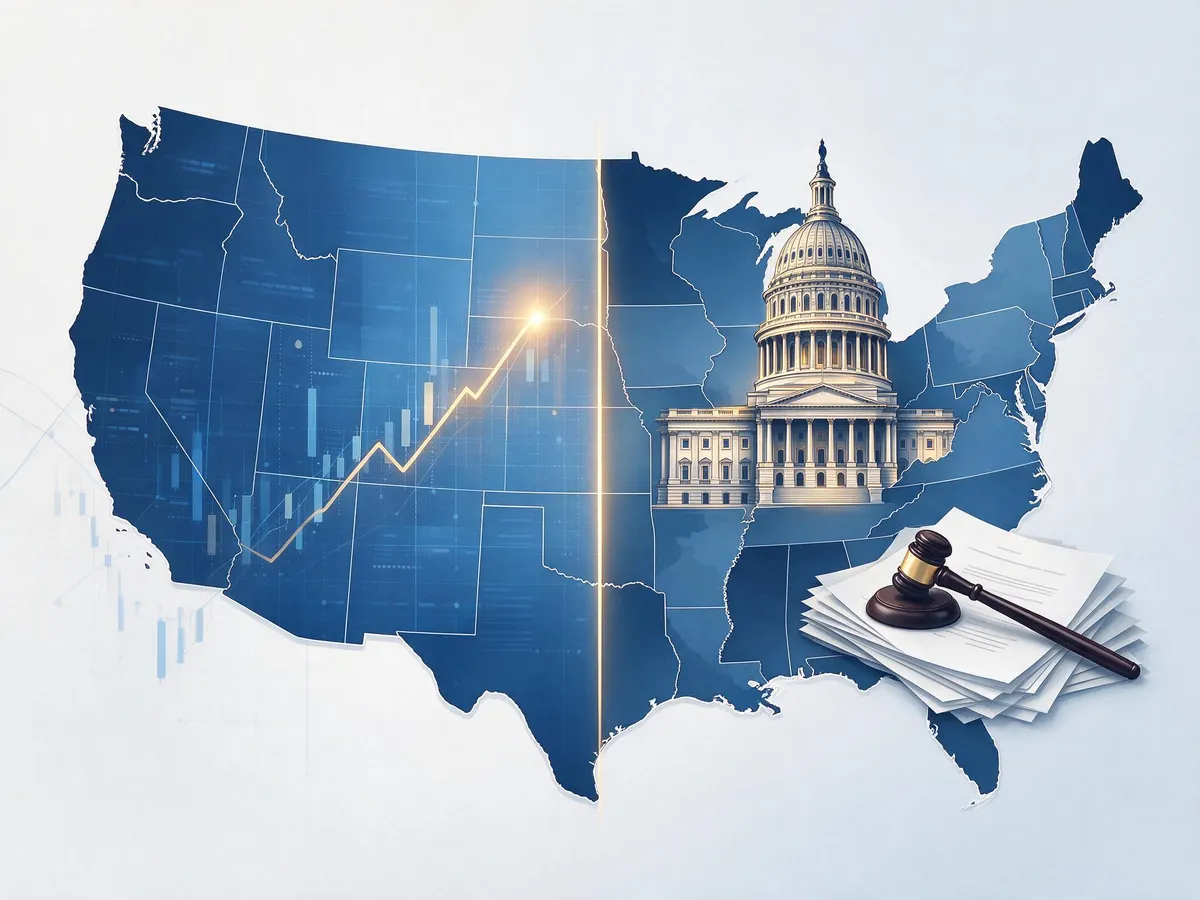
A prediction market is an exchange where people trade contracts on whether a future event happens, and the price doubles as a probability. That is the tidy definition. The messy version is the one the US industry is now fighting over: when the event is “will the Chiefs cover the spread,” the same contract looks like a federally regulated derivative to one regulator and an unlicensed sports bet to another. Two developments landed on the same day and pull in opposite directions. Kalshi signed partnerships with four Native American tribes to launch prediction-market apps. Coinbase agreed to stop offering sports event contracts in Michigan.
The Kalshi tribal partnership, in concrete terms
Four tribes have agreed to launch their own prediction-market apps using Kalshi’s plumbing. They are the Alabama-Quassarte Tribal Town in Oklahoma, plus three California tribes: Greenville Rancheria, Kletsel Dehe Wintun Nation and Alturas Indian Rancheria.
The split of responsibilities is the part worth reading twice. Each tribe will own its customer-facing platform outright, which means it controls the brand, the marketing and the customer relationship. Kalshi supplies the trading infrastructure and the liquidity that makes the order book function. In other words, the tribes get a consumer business; Kalshi gets distribution and volume without building four more front ends.
These deals follow a similar arrangement Kalshi struck with the Tunica-Biloxi Tribe of Louisiana about three weeks earlier (Sept. 18, 2026 vs. the Oct. 7, 2026 four-tribe deals), so this is a pattern rather than a one-off. Four signatures in a single announcement, though, turns a pilot into a strategy.
Why this splits tribal gaming rather than unites it
Here is the friction. Many tribal gaming organisations are currently in court against Kalshi, arguing that its sports event contracts amount to sports betting offered without state or tribal authorisation, and that they erode the exclusivity tribes negotiated through compacts. Those compacts are the economic foundation of tribal gaming: in exchange for revenue sharing and geographic limits, tribes got protected rights to offer certain games.
A nationally available app that offers something a customer experiences as sports betting, without a state licence or a compact, is a direct threat to that bargain. That is the case the litigating tribes are making.
The four tribes signing with Kalshi have made the opposite calculation: if event contracts are going to exist anyway, better to own a piece of the channel than to spend years litigating it. For a smaller tribe without a large casino footprint, a digital platform with national reach is a materially different opportunity than a land-based property. That is not a contradiction so much as a different risk appetite, and it is why the divide inside tribal gaming is now as newsworthy as the divide between Kalshi and the states.
Coinbase’s Michigan exit points the other way
While Kalshi expands its footprint, Coinbase has agreed to halt sports event contracts in Michigan. One company is adding distribution partners; the other is subtracting a state.
The contrast matters more than the size of the Michigan market. Kalshi’s posture has been to litigate, arguing that as a federally regulated exchange it answers to the Commodity Futures Trading Commission rather than to 50 separate gaming regulators. Coinbase, a publicly listed company with a crypto regulatory history of its own, chose to step back from a contested state instead of adding another courtroom to its calendar.
For anyone trying to read where this is heading, that divergence is the signal. The legal question is unresolved enough that two well-capitalised firms can look at the same risk and respond in completely opposite ways.
Thirty-nine states and the Supreme Court
The third piece of the picture is the one that could make the first two moot. Thirty-nine states plus Washington, D.C. are urging the Supreme Court to review a ruling that went in Kalshi’s favour in New Jersey.
That is an unusually broad coalition of state attorneys general and gaming regulators lining up on the same side of a single question: whether federal commodities oversight pre-empts state gambling law when the underlying event is a sports result. Lower courts have not answered consistently, which is precisely the argument for the Supreme Court taking it up.
If the court declines, Kalshi’s position hardens and the tribal partnership model becomes a template other exchanges will copy. If it takes the case and rules for the states, every distribution deal signed this year needs rewriting, including the four announced here.
What this actually changes in practice
For customers, the short-term effect is geographic. Depending on the state and the operator, the same type of sports event contract may be available, withdrawn, or available only through a tribally branded app that did not exist a quarter ago. Michigan users of Coinbase’s product lose access to sports contracts; users in states where Kalshi operates may see new branded apps appear with the same underlying order book behind them.
A few practical points worth being clear about:
- These are exchange-traded contracts, not fixed-odds bets. You are trading against other participants at a price, and the platform typically takes a fee rather than building in a bookmaker’s margin. That is a genuine structural difference, not a better deal by default.
- The price of a contract is an implied probability. A contract trading at 60 cents on a dollar payout implies roughly a 60% chance. Fees, spreads and the risk of being on the wrong side of better-informed traders all still apply, and the long-run expectation for most participants is negative.
- Consumer protections are not automatically identical to those in licensed sportsbooks. State gaming regimes carry specific requirements around deposit limits, self-exclusion and advertising. A federally regulated derivatives venue is built on a different rulebook, which is part of what the states are objecting to.
For operators, the reshuffle is about optionality. Licensed sportsbooks have spent years and significant money on state-by-state approvals. If event contracts reach a similar audience without that overhead, the licensing cost becomes a competitive disadvantage rather than a moat, which explains why the pushback has been so coordinated.
The broader scrutiny is not letting up either. Senator Richard Blumenthal is widening his inquiry into VIP programmes at betting operators, and analysts at Macquarie expect uneven third-quarter results across the sector. Prediction markets are growing into a regulatory environment that is getting tighter, not looser.
None of this changes the basic arithmetic for an individual participant. Whether the product is a sportsbook bet or an event contract, the money at risk is real and the long-run edge does not sit with the customer. Treat the budget as entertainment spend, use deposit and session limits where they are offered, and if it stops feeling optional, use the self-exclusion tools or a national helpline.
The tribal partnerships and the Michigan exit are the same story told from two ends: a legal question big enough that expansion and retreat are both rational responses to it. The Supreme Court’s decision on whether to hear the New Jersey case is the next thing to watch.