
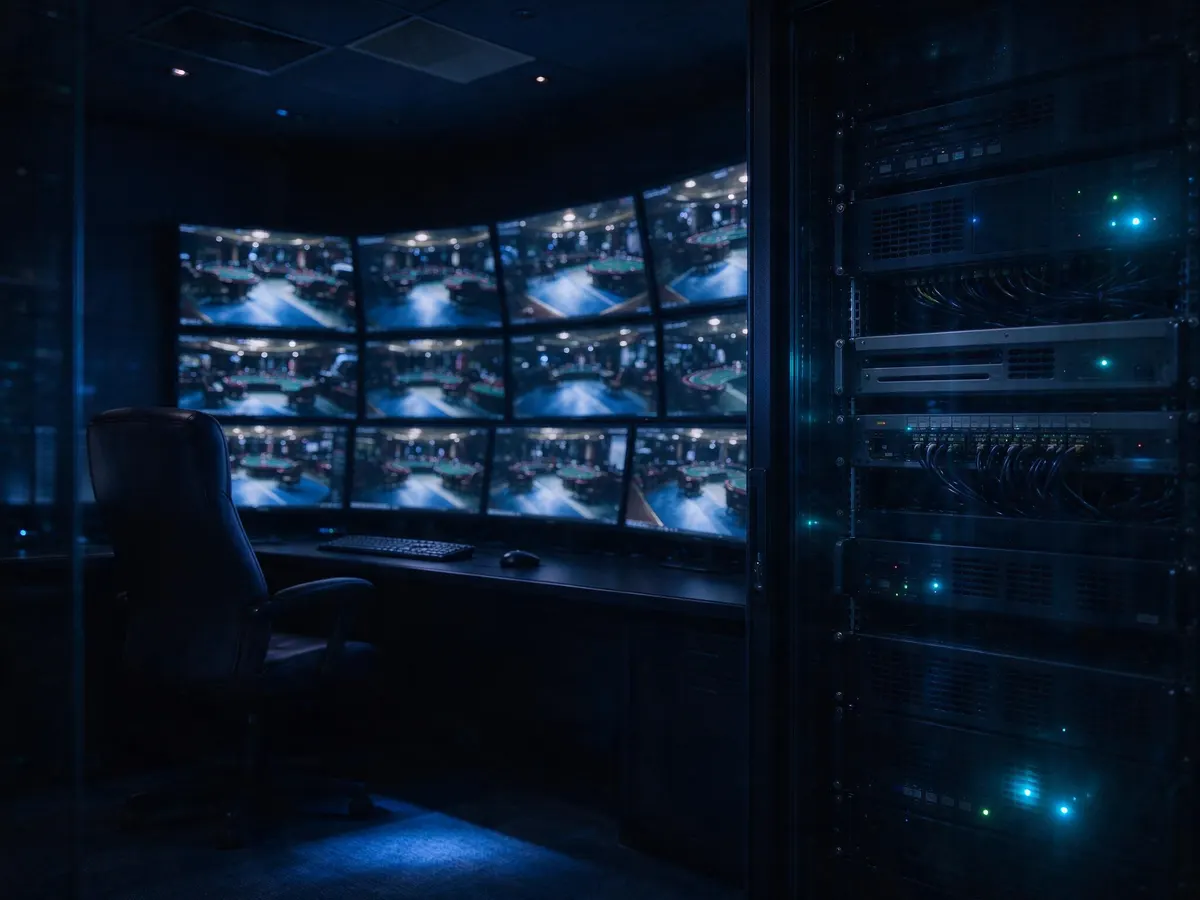
eConnect didn’t bolt AI onto its casino surveillance platform. It tore the platform down and rebuilt it from the ground up, and the reason has less to do with model quality than with a single line in a procurement conversation: the data stays behind the operator’s own firewall.
That choice, laid out by eConnect president and CEO Henry Valentino in a video interview with CDC Gaming, is the clearest signal yet of where this corner of the industry is heading. On premise AI in gaming is no longer a niche preference for paranoid compliance departments. It is becoming the default architecture for anything that touches camera feeds, player identities or loyalty records, because operators have worked out that the AI question and the data residency question are the same question.
What the rebuild actually tells you
Adding AI features to an existing product is cheap and fast. You hand the heavy lifting to a third party API, send the frames or records out, get predictions back. Almost every vendor pitching AI in 2024 and 2025 did exactly that, which is why so many demos look identical.
Rebuilding a platform so inference runs on hardware sitting inside the casino is a different commitment. It means re-architecting how video is ingested and indexed, sizing GPU capacity per property rather than renting it by the hour, and shipping model updates to sites instead of pushing them to one central cluster. Nobody does that work for marketing reasons. They do it because customers told them the alternative was disqualifying.
Valentino’s framing in the interview is worth sitting with: the on-premises approach lets casinos use AI while sensitive player and operational data never leaves their own network. Strip out the vendor language and what remains is a design constraint, not a feature.
Why casino data privacy pushed the architecture on site
Three pressures are converging, and only one of them is reputational.
Regulatory exposure. Gaming regulators already dictate how surveillance recordings are retained, secured and made available for inspection. Sending those recordings to a third party data centre in another jurisdiction turns a settled compliance posture into an open question nobody wants to litigate during a licence review. In Europe, facial images used to identify an individual fall under GDPR’s special category rules for biometric data, which raises the legal bar again. And for tribal operators in the United States, data about their own property and patrons is frequently treated as a sovereignty matter, not merely an IT one.
Breach liability. Casino operators have had a brutal education in this over the past few years. Every external pipeline carrying player identity data is another place a breach can originate, and another vendor whose security posture you inherit. Player data security improves in the simplest possible way when the data has fewer places to be.
Latency and dependency. Surveillance analytics are only useful in something close to real time. A round trip to a remote data centre adds delay and makes the system dependent on a connection that, on a Friday night at a busy property, you cannot afford to lose. Edge computing in gaming isn’t an aesthetic preference here; it is how you get an alert to a floor supervisor while the incident is still happening.
On premise, cloud and hybrid: the honest trade-offs
Running AI without cloud dependency solves real problems and creates others. Anyone evaluating this should go in with both columns in view.
| Factor | On premise | Cloud | Hybrid |
|---|---|---|---|
| Where sensitive data sits | Inside the operator’s network | Third-party infrastructure | Raw data local, aggregates exported |
| Inference latency | Local, no network round trip | Depends on link quality | Local for time-critical tasks |
| Cost shape | Capital spend on hardware per site | Operating spend, scales with usage | Both, harder to forecast |
| Scaling for peaks | Limited by installed capacity | Elastic | Burst only non-sensitive workloads |
| Model updates | Pushed to each property | Centralised and immediate | Mixed, needs version discipline |
| Regulator conversation | Simplest to explain and audit | Requires vendor and transfer scrutiny | Needs a clear data map |
The cost line is the one operators underestimate. GPUs in a server room get bought once and then age, while a cloud provider quietly upgrades its fleet for you. Multi-property groups also end up maintaining the same stack a dozen times over. If a vendor tells you on premise is cheaper, ask them to model year three.
Beyond the camera: where the value case actually sits
Surveillance is the entry point, not the destination. Valentino’s third point in the interview is that AI could help casinos make better use of data they already collect, including identifying uncarded players and sharpening operational decisions.
That one is quietly significant. Uncarded play, a guest gambling without a loyalty card, is a genuine blind spot. Operators know roughly how much of their floor revenue is unattributed, and they cannot market to, reward or properly value a player they cannot see. Matching camera data to play patterns closes that gap. It also means a system built for security starts producing commercial intelligence about individuals who never opted into a loyalty programme.
Which is precisely why keeping the processing on site matters more as the use cases expand. The broader the inference, the worse the optics and the legal position if that pipeline runs through someone else’s infrastructure. Operators adopting this should be writing internal policy on retention, access and purpose limitation at the same time they are racking the hardware, not eighteen months later.
There is a responsible gambling dimension here too. The same on-site analytics being sold for theft detection and player rating are increasingly pitched as a way to spot markers of harm, such as unusual session length or escalating stakes. Used carefully, with clear limits on who sees what and what action follows, that is a reasonable application. Used as a pretext to hoover up behavioural data, it isn’t. Players who want to control their own exposure should rely on the tools they can see and set themselves: deposit limits, loss limits, session reminders and self-exclusion.
What to press vendors on
If you are assessing an AI claim in this category, these questions separate architecture from positioning:
- Does any raw video, image or player identifier leave the property, including for model training, telemetry or support diagnostics?
- Where exactly does inference run, and what happens to the system when the internet connection drops?
- Who owns the data the models generate, and can it be exported or deleted on the operator’s terms?
- How are model updates validated before they reach a live floor, and can a bad version be rolled back?
- What hardware is required per site, and what is the realistic refresh cycle and cost?
- How does the deployment map onto existing surveillance regulations and, where relevant, GDPR or tribal data policy?
Among the gaming technology trends worth tracking into the next trade show cycle, this one is unusually easy to verify. Ask where the inference happens. Vendors who rebuilt for it will answer in one sentence. The rest will talk about encryption in transit.
