
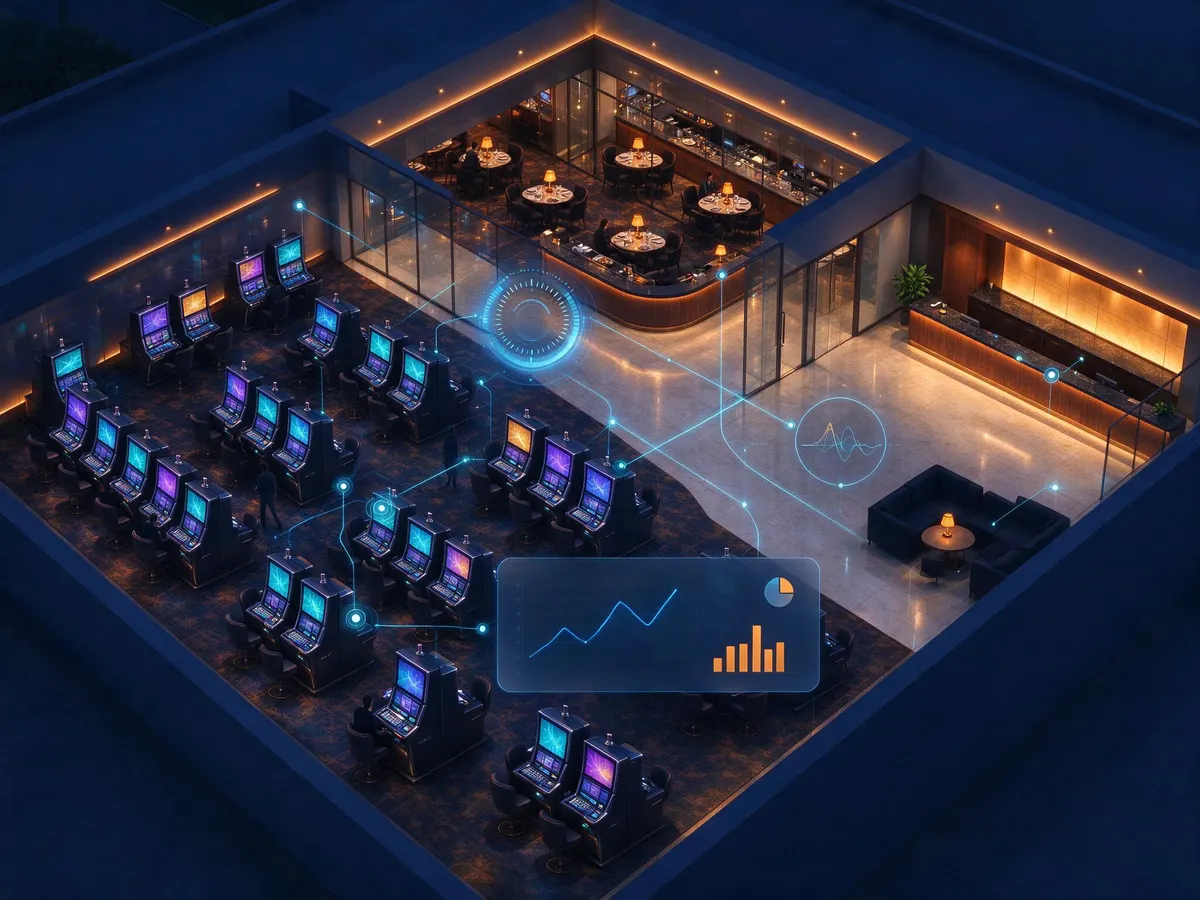
The casino does not already know everything about you
That is the myth worth killing before anything else. Players assume a resort runs on one giant brain: you tap your loyalty card into a slot machine, and somewhere a system instantly knows you skipped dinner, that your flight lands at 11pm, and that you lost ₹8,000 last Tuesday. The reality in most properties is far clumsier. The slot system knows one thing, the hotel system knows another, the restaurant till knows a third, and the marketing database knows a stale copy of all three. Getting those systems to agree on who you are, right now, is the hard problem the industry has been chewing on for two decades.
That gap is exactly what Quick Custom Intelligence (QCI) took to Las Vegas. The company spent Global Gaming Expo (G2E) 2026 pitching what it calls unified resort operations, and its reception there is a useful signal about where casino management software is heading: away from best-of-breed silos, toward one shared operational picture. My argument is simple. This shift will change the guest experience more than any new slot cabinet on that show floor, and it deserves more scrutiny on the data side than it usually gets.
What QCI actually brought to Las Vegas
G2E 2026 ran 28 September to 1 October at The Venetian Expo in Las Vegas, the industry’s biggest annual gathering. QCI used it to connect with existing customers, run live demonstrations, and put its vision for unified resort operations in front of operators from multiple markets.
The centrepiece was QCI Resorts, described as a unified platform that pulls hospitality, food and beverage, marketing, loyalty, guest engagement and enterprise operations into a shared operational environment, with gaming systems integrated where a property needs them. Alongside it, the company expanded the capabilities of QCI Metrics and presented the QCI Resorts Experience. The pitch throughout was real-time intelligence supporting decisions across the whole property rather than inside one department. QCI’s Dr. Ralph Thomas and Andrew Cardno fronted the presence, which also included a branded RV activation next to the demo stations, a notably physical way to sell abstract software. (Details per G3 Newswire’s report on QCI at G2E 2026.)
Read the vendor language carefully and the substance is less about invention than about plumbing. “Shared operational environment” means a single place where numbers from different systems sit side by side and refresh fast enough to act on. That is not glamorous. It is also the thing most resorts genuinely lack.
What “unified” means once you strip out the marketing
A mid-size casino resort typically runs four or five separate record-keeping systems, each built for a different job and each holding a partial version of the same guest.
| System layer | What it records | What goes wrong when it stands alone |
|---|---|---|
| Slot and table player tracking | Carded play, theoretical win, time on device, denomination and game choice | Hosts see gambling behaviour with no idea what the guest spent or experienced elsewhere |
| Loyalty and CRM | Tier, points, comp balance, offer history, contact preferences | Offers land days late and are based on last month’s behaviour |
| Hotel property management | Reservations, room rate, arrival and departure, room inventory | Rooms get priced and allocated without reference to a guest’s actual value |
| Food, beverage and retail point of sale | Covers, spend per head, wait times, voucher redemption | Comped meals and paid meals look identical in the numbers |
| Enterprise and finance reporting | Labour, margin, departmental P&L | Decisions get made on yesterday’s close, not today’s floor |
Unified resort operations means one layer sitting over all of that, reading from each system and presenting it as a single view of a property and a single view of a guest. The loyalty account is the join key that makes it possible. Every card tap, room charge and restaurant bill carries the same player ID, so the platform can stitch together a sequence rather than five disconnected fragments.
That is why the integration-with-gaming-systems-where-required phrasing matters. Slot accounting and player tracking are heavily regulated, audited, and often locked to a legacy vendor. Any platform claiming to unify the resort has to treat the gaming floor as a system it reads from and cooperates with, not one it rips out.
What actually changes at the slot machine
For players, the visible effects are small and cumulative rather than dramatic.
- Faster, more relevant offers. A free-play or dining offer triggered by this afternoon’s session rather than a monthly batch mailing. Better targeting also means fewer irrelevant promotions clogging your inbox.
- Hosts who arrive with context. A host who can see you have been on property since noon and have not eaten is more useful than one working from a printed worth report.
- Fewer repeated explanations. If the hotel desk, the cage and the restaurant read from the same record, you stop re-stating your tier at every counter.
- Operational tuning you only notice indirectly. Staff moved to a busy pit, a second buffet line opened, a machine bank serviced before it sits dead for an hour.
What does not change is the mathematics of the games. No operations platform alters RTP, house edge or the independence of RNG outcomes. A 96% RTP slot returns the same long-run average whether the property runs a unified platform or five spreadsheets. Unified operations are about how a resort spends on you and schedules around you, not about how a game pays. Anyone implying otherwise is selling something.
The data question nobody asks on the trade show floor
Here is my real reservation. The pitch for unified casino player data is always framed around personalisation, and personalisation is the friendly word for profiling. A joined-up record of your gambling, your spending, your room nights and your movements around a property is a genuinely sensitive dataset. It is more revealing than anything a supermarket loyalty scheme holds.
Three things deserve asking, whether you are an operator buying this software or a player carrying the card that feeds it:
- Scope. Does the platform collect what the operation actually needs, or everything it technically can? Unification makes over-collection trivially easy.
- Retention and access. How long is a joined-up profile kept, who inside the business can open it, and is that access logged? A single view of the guest is also a single point of exposure.
- Player rights. Regulated markets give players the ability to request their data and to use self-exclusion, deposit, loss and session limits. A unified platform should make both easier, not bury them across five systems.
There is a genuinely positive version of this too, and it is worth naming. The same joined-up data that spots a profitable guest also makes it far easier to see patterns that suggest harm: escalating session lengths, chasing behaviour, spending that no longer looks recreational. Operators in regulated markets are increasingly expected to identify and act on those markers. Siloed systems are a convenient excuse for not seeing them. Unified ones remove the excuse, which is an argument for this technology that vendors underuse.
Why the whole sector is drifting this way
QCI is not alone, and that is the point. Current iGaming technology trends run in the same direction: cloud-hosted back ends, real-time data instead of overnight batches, and consolidation of tools that used to be bought department by department. Land-based operators watched online brands run single-customer-view marketing for years and noticed the gap. Meanwhile, properties that have both a casino floor and an online or retail sportsbook arm need one record of a customer who moves between them.
A trade show appearance is not a product verdict, and a successful booth proves interest rather than outcomes. The signal from G2E 2026 is one of direction: the competitive question in casino management software is shifting from who has the best individual module to who can make a resort behave like one business. Watch for the dull evidence over the next year, which is integrations and named deployments rather than demo videos.
If you play, carry the card knowingly. It buys you comps and tier benefits, and it is also the thread that ties your record together. Set your own deposit, loss and time limits, use the self-exclusion tools if play stops being entertainment, and treat gambling as paid entertainment with a built-in house edge, because over time that is exactly what it is.